‘Christmas Carol’ production puts new spin on old tale

Brad Carroll admits that, when he was offered the opportunity to direct Nevada Conservatory Theatre's production of "A Christmas Carol," he found himself at a bit of a loss.
"When you say the words 'A Christmas Carol,' everyone has some sort of association with it," explains Carroll, the production's aptly named -- yes, Carroll has heard all of the "a guy named Carroll directing 'A Christmas Carol' '' jokes -- director.
While humanity's nearly universal familiarity with the story is "a good thing," Carroll says, "the first thought that went through my head when I was offered this production was: What in the world am I gonna do to make it special?
"Pretty much everything's been done to it -- the Muppets and Mr. Magoo and, now, Jim Carrey's new movie version. So, the challenge is, how do we make it fresh, how do we make it new, how do we make it specific to this group of people and this theater's capacities?"
Luckily, Carroll found an answer when he read a note at the very beginning of the 1978 adaptation by David H. Bell.
"It says, 'The lights rise, and we see Scrooge standing among a lifetime's worth of foreclosure acquisitions.' And then it says, 'The space is a haunting of other people's lifetime's goods.'
"And it was just a new slant," Carroll says. "We knew Scrooge runs a counting house, but, really, what is that? And, in this adaptation, it's really more of a repossession house."
Given the state of the economy, mounting job losses and the slew of foreclosures Southern Nevada has seen, Carroll says, the story "couldn't be more relevant."
The adaptation offers "several themes that have been interpolated into it in a way I've never seen in any other 'Christmas Carol' adaptation that are specific to foreclosure," Carroll says, but "it doesn't feel like we're hitting the audience over the head with it. It's really well-structured and that, in and of itself, is what really interested me and hooked me into wanting to do it."
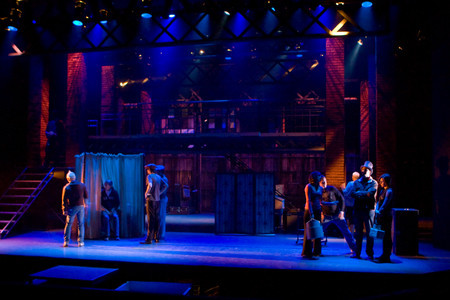
Adding to this theme is the setting: The play is set in a warehouse filled with items taken by Scrooge in foreclosures. In fact, Carroll jokes, "I think people are going to come into the theater and see the setting and almost think they were in the wrong place."
But, Carroll says, "Everything we need to tell the story is there, because it's all foreclosure items -- tables and chairs and dishes, just everything. And metaphorically, of course, this room is full of stuff that, if you will, sort of represents the space of Scrooge's soul: just a cluttered mess. And add to that the fact that it's other people's belongings that were taken from them, and there can't be good energy in that."
Still, "A Christmas Carol" remains a tale of redemption, with Scrooge -- and us -- realizing in the end that material goods aren't the most important things, during this season or in this life.
"It's really about the people in this production," says Carroll, who knew from the outset that "I didn't want to do the happy, snowy streets of London because, on the foreword page of Dickens' book, he calls it 'a ghost story of Christmas.' So we really wanted to delve more into the dark side, for lack of a better word. Three-fourths of the story takes place in the spirit world.
"It's turning out to be a wonderful process," he adds. "It almost makes me feel like we're doing a new play."
At the same time, NCT's production features period costumes and retains "the traditional Dickensian (touches) people are going to want."
Carroll also likes the fact that the production will "ask the audience to really engage their imagination. So when we go to the Cratchits' (home), it's a table and benches and some people. Scrooge's office is a couple of desks.
"I think one thing theater is supposed to do is engage the imagination of the audience, and that's one thing this production will really do, and in an inviting way, not an intimidating way." In the end, "it comes back down to people," Carroll says. "It's about people, and it's about love.
"It's essentially a redemption story. Yes, it's about all those other things, but at it's very core, it's about someone finding their way to happiness, and everybody is on some sort of spiritual quest like that," Carroll says.
"To get to see somebody make that journey and come out at the other end a changed person who's now trying to right all his wrongs is pretty powerful."
Contact reporter John Przybys at jprzybys @reviewjournal.com or 702-383-0280.
Preview
"A Christmas Carol" presented by Nevada Conservatory Theatre
8 p.m. today, Saturday and Thursday; 2 p.m. Sunday (through Dec. 13)
Judy Bayley Theatre, University of Nevada, Las Vegas, 4505 S. Maryland Parkway
$20-$30 (895-2787)