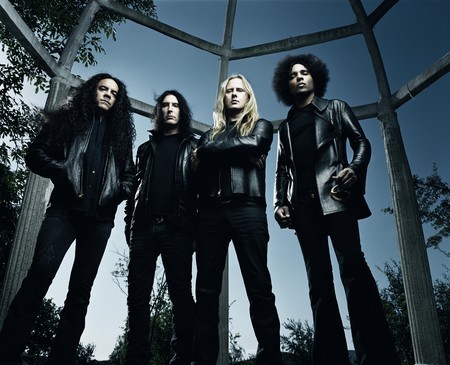
Alice in Chains acknowledges past while building future

Long before fronting a storm-cloud-of-a-rock band that helped define an era and sell more than 14 million records along the way, William DuVall was having Henry Rollins over to sleep on the floor of his parents' house.
A veteran of the Atlanta punk circles as a teen in the early '80s, where he helmed agit-prop antagonists Neon Christ and played alongside underground greats such as Corrosion of Conformity and B'last, DuVall fondly recalls hunting for Die Kreuzen 7-inches as a kid, arguing over who was the best of Black Flag's four singers and helping to provide the brick and mortar upon which a scene was built from the ground up.
"That was such a great time for self-determination among youth," Duvall recalls from a tour stop in Switzerland, while on the road with his current band, grunge prime movers Alice in Chains. "Man, it's the core of my being. It gave you a real strong sense of, 'I can do this myself.' The fanzine that you want to read isn't being made by somebody? Well, then, you make it. This was a time of 14-, 15-year-old kids starting their own record labels, booking their own tours. It was this network that went all across the world. You'd receive handwritten letters from Finland or Japan saying, 'May I please have your EP?' It was transformative for the culture."
That DIY culture eventually would bubble up into the mainstream during the alt-rock boom of the early '90s, when America became temporarily transformed into an alternative nation and indie bands such as the Melvins, Seven Year Bitch and the Jesus Lizard were somehow getting major label deals.
Seattle served as the epicenter of it all, so in a way, Duvall has come full circle by joining one of the city's most famous exports of that era in 2006.
Of course, he did so under unenviable circumstances, replacing the band's deceased singer, Layne Stanley, who died in 2002 from a drug overdose.
Staley was always a turbulent presence, but he was a great frontman, with a voice that distilled all the pathos that clouded his life in grand and stirring fashion.
Duvall doesn't want to feel like he's filling in for anyone. He's cognizant of the past, naturally -- he sings songs Staley made famous every night -- and so the goal is to somehow stay true to the material and to himself in the same breath.
"Was I aware of all the noise and the debate going on in the outside world? Yeah, sure," Duvall says of replacing Staley. "And I'm still aware of it, but the only way to answer that is to forge ahead and let the chips fall where they may. And that, from day one, is all I ever set out to do. When we first started touring, we didn't know how long this thing was going to go on. Originally, it was just a few shows booked in 2006. (Singer/guitarist Jerry) Cantrell, who's an old friend of mine, he called me up and said, 'Would you like to do these shows with us?' Those few shows turned into this 23 country world tour that we did. So it ended up taking on a life of its own."
After more then two years on the road, the band eventually hit the studio to record its first album in 14 years, the recently Grammy nominated "Black Gives Way To Blue."
There are distinct Alice in Chains flourishes on the disc, particularly Cantrell's haunted harmonies and ashen riffs.
Cantrell does a lot of singing on the record, so there are certainly parallels to the band's past, particularly its last album with Staley, 2005's "Alice in Chains," where Cantrell assumed a larger vocal role.
But DuVall clearly makes his presence felt on "Black." For one, he plays guitar, further beefing up the band's sound in that department. And he sings in a distinct, soulful rumble that meshes well with Cantrell's softer, moodier voice.
But perhaps the main difference in Alice in Chains these days is that a few rays of sunshine now penetrate the darkness that's long shrouded the band, practically entombing it in gloom at one point. "In your darkest hour, you strike gold," Cantrell and DuVall sing on "Lesson Learned," a line that could encapsulate all that this band has been through -- and, by extension, its newest record as well.
"Those types of things are just a natural reflection of how everyone in the group was feeling given the circumstances of a new beginning," DuVall says of the more galvanized tenor of "Black." "I think that there was always a bit of a survivor element in Alice in Chains' music from the beginning. Like a song like 'Rooster,' 'He ain't gonna die.' Even some of the darker songs, like 'Junkhead,' there's this defiance about them. But I think whereas before the death-trip-to-survivor ratio might have been 70 to 30 death trip, maybe now it's 70-30 survivor. We're all survivors of a certain stripe, you know?"
But it's one thing to survive, and it's another to prosper. DuVall is well aware of this. And to this end, he knows that he has to acknowledge the past, while simultaneously building upon it. "Hate, long wearing thin. Negative all you've been," he sings on the dusky "When the Sun Rose Again," "It's time to trade in never-befores."
And he sounds ready to live up to those words.
"It obviously has roots in what happened in the past, but it's become its own thing," Duvall says of the band's current direction. "This band has never been for everybody, even in the past. Why should it be any different now?"
Contact reporter Jason Bracelin at jbracelin@ reviewjournal.com or 702-383-0476.
Preview
Holiday Havoc '09, with Alice in Chains
8 p.m. today
The Joint at the Hard Rock Hotel, 4455 Paradise Road
$39.50-$150 (693-5583)