Exhibit recalls distinctive Las Vegas structures from another era

Eager young ladies -- a pulchritudinous pair of gal pals, as sleekly built, seductively angled but subtly outfitted as the hotel behind them -- are about to hop out of a cool-daddy-o convertible, a bellman standing by. (What's really on that guy's mind, besides fetching their luggage?)
Captured forever in a photographer's lens, their retro world is black and white, the simple but oddly dreamlike palette with which the 1950s were painted. Their hipster host -- low to the ground, set back from the street as if guarding its charms, designed with a style that understands the sexiness of understatement now largely discarded in contemporary, overstuffed Las Vegas -- is the Sands.
Flip the ignition on the way-back-when machine.
"If you look at old photographs of the Strip, the hotels were on a human scale, and you didn't feel overwhelmed. There was elbow room," says Dennis McBride, curator of history and collections for the Nevada State Museum Las Vegas. "In this relatively brief period of time, between the end of World War II and the oil embargo of '73, Las Vegas had a very specific look."
Take an extensive, detailed look at that look in the museum's ongoing "Mid-Century Modern Las Vegas Architecture" show.
Surprisingly, as you enter the exhibit likely expecting a tour mostly through the scaled-down Strip of yesteryear that spawns such eulogizing and rhapsodizing, you're drawn toward the local structures of everyday, unglamorous use. Featured are photos of dozens of schools, shopping centers, medical and government buildings, even private homes and apartment complexes, as well as the University of Nevada, Las Vegas and McCarran International Airport -- enticing the eye with lively splashes of modernism and futuristic flair.
Some, even in implosion-crazy Las Vegas, stand tall to this day.
"People tend to dismiss Las Vegas architecture, but there's some wonderful things here," says museum director David Millman about the style applied to city structures by architects including Paul Revere Williams, Palmer and Krisel, Zick and Sharp, Wayne McAllister and Welton Beckett. "Most people who live here have their routines and don't notice a lot about the city because there's a lot that's hidden. This is a really interesting slice of Las Vegas. It adds some depth to living here."
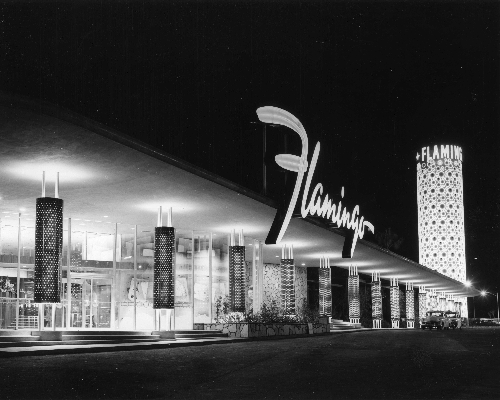
Glitzwise, Vegas is covered, with atmospheric images of the Mint on East Fremont Street in 1957, with its curved, upward-looping archway, and the fashionable Flamingo exterior in 1955, sporting a row of cylindrical lampposts lighted from within, a similarly designed "champagne tower" looming overhead. "They hadn't built high-rises yet except the Riviera, which was several stories high," McBride says. "People worried and complained that people were going to jump off it."
Back at the Sands -- i.e., "A Place in the Sun" -- a marquee announces the appearance of Tallulah Bankhead and someone named Sinatra. Ray Sinatra. And his orchestra; a 1961 photo finds the La Concha Motel under construction, its signature parabolic section and shell-shaped lobby -- what McBride calls "a Jetsons kind of design" -- dominating the landscape; and in a snapshot from 1968, the Union Plaza rises up against a mountainous backdrop.
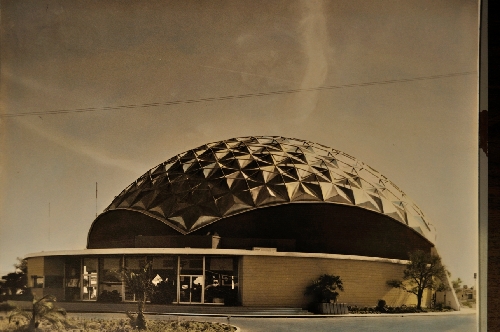
Off-Strip are photos of the quirkier gems: the helmet-style roof of the Cinerama Theatre; the still-standing Fleur De Lis Villas apartments featuring colored glass brick; the Paradise Valley branch of the Bank of Las Vegas with its metal screening that helped block sunlight; the former Review-Journal building on North Main Street, the decorative cinder block grid enhancing the facade; the butterfly roof of the Sears Roebuck building on Maryland Parkway; and the flying saucer-shaped Las Vegas Convention Center.
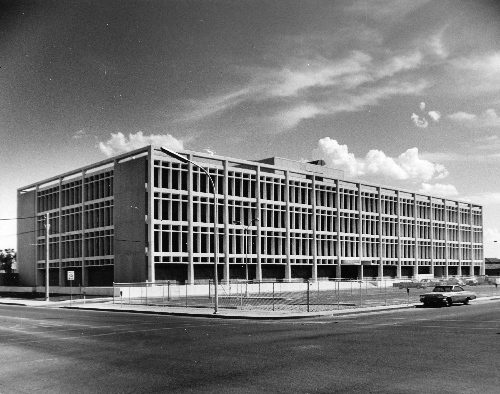
Parading through are imaginative layouts and modernistic touches that grace such spots as UNLV's Flora Dugan Humanities building, the Foley Federal building, the Southern Nevada Health District headquarters, Somerset Gardens apartments, the Sahara-Rancho Medical Center, Valley High School, the Gorman High School Chapel, Temple Beth Shalom and the interior of the McCarran terminal.
Interspersed throughout are glassed-in displays of accessories from those decades, such as ashtrays, crockery and candlestick holders.
"You can see the correlation in the designs of this stuff with the designs of the architecture," McBride says. "The parabolic ashtray that reminds you of the La Concha lobby, or ones with designs that look like archways in front of the Sands."
Used, no doubt -- in those puff-happy days of yore -- by a pair of pulchritudinous partyers during a wild weekend romp with one lucky bellman.
Contact reporter Steve Bornfeld at sbornfeld@ reviewjournal.com or 702-383-0256.
Preview
"Mid-Century Modern Las Vegas Architecture" exhibit
9 a.m.-5 p.m. Wednesdays-Saturdays
Nevada State Museum,
700 Twin Lakes Drive in Lorenzi Park
$4 for adults, 17 and under, and museum members admitted free
(486-5205; www.NevadaCulture.org)

 Add as a preferred source on Google