An Unlikely Artist

You may think of Lonnie Hammargren as a retired Las Vegas neurosurgeon, a former Nevada lieutenant governor and, of course, a big-time collector of stuff great and small.
But here's something you -- and, certainly, Hammargren's neighbors who have expressed occasional exasperation with the doctor's ever-growing collection -- may never have thought of Hammargren as.
An artist.
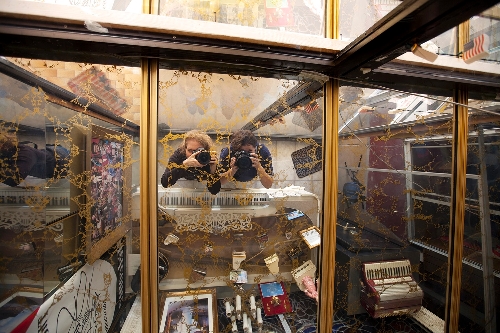
The judgment comes from two people who should know: Heather Protz and Linda Alterwitz, who spent the past two and a half years photographing items in Hammargren's collection.
Starting today, the artists will display a few -- and, they agree, it's just a very few -- of the photographs they've taken in "Lonnie," a photography exhibit at the art gallery of the Sahara West Library, 9600 W. Sahara Ave.
The exhibit kicks off today with a reception from 6 to 8 p.m. and is scheduled to run through Sept. 19.
Alterwitz admits that it didn't occur to her initially that Hammargren's collection might be fodder for a show. Nor did she initially expect Hammargren's collection to amount to much more than a conglomeration of random stuff.
But, after she and Protz began shooting, "I began to see things in a different way," Alterwitz says. "Heather and I have talked about it a lot, but he's an artist in his own right."
As well as, Protz adds, "a curator of history."
"He has a story for every element," Alterwitz agrees.
Neither woman had met Hammargren before beginning the project. However, Alterwitz did know Hammargren's son. From there, Protz says, all it took was a phone call for Hammargren to invite the photographers into his home.
Hammargren says that, at first, he assumed the photos Alterwitz and Protz were taking would be merely part of a larger exhibit. Only later, when an e-mail about the upcoming show arrived, did he learn that the show would focus exclusively on his collection.
That also was when Hammargren learned that his first name would serve as the show's title.
"That's interesting, too," he says, how "they're using one word, like 'Wayne' (Newton) or something like that."
He laughs. "It's the first time I've graduated to that status, where it's just my first name."
Protz and Alterwitz visited Hammargren's home several times a year for shooting sessions. Their first visits were spent "just getting the lay of the land," Protz recalls. "Then you start to see things emerging."
"It took me a while to realize ... what he was doing within his home," Alterwitz agrees. Eventually, she realized that the array of items Hammargren has collected, and the continually shifting ways in which he displays the items, are about "blending art and science."
"There is so much method and so much thought put into it, it's really kind of genius," Alterwitz says.
During the project, Protz noticed that Hammargren's collection is more focused than some might imagine. For instance, she says, the collection reveals Hammargren's passionate interest in medicine, the natural and physical sciences, technology and Nevada history.
"You're not out in the back 40 with a whole bunch of cars parked and rusting away," Protz adds. "It's something he takes care of and moves and perfects. Every time we go, it's different."
Hammargren would agree that his collection represents a form of art.
"The common thread here ... and it's a cloth, not a thread, is, it's an expression of human achievement," he says.
In coming to know Hammargren's collection, the artists also came to know something of the man. Alterwitz recalls an early session, when she and Protz were touring a room featuring items from Hammargren's mother. One of the items was "a poem his mother wrote that was in a book.
"He said: 'I want you to listen to this.' We sat down and just listened to him read this poem his mother wrote. He was just genuinely happy. It was like he could just show this great, emotional side of him.
"It was really amazing," Alterwitz says. "It wasn't just, 'Look at what I have.' It was genuine."
And even if Hammargren's de facto museum is, technically speaking, a private one, "he's so open and generous," Alterwitz adds.
Hammargren has hosted numerous guests in his home, Protz notes, and, during their own visits, "he just lets you wander through. He didn't know us when he met us. He didn't follow us around. We had free rein of the place."
That freedom on one occasion led to a scene familiar to fans of B horror flicks. Alterwitz recalls that she and Protz had split up to explore different rooms of the home when "I kind of got locked in this room.
"And I'm, like, 'OK, I can call Heather and she'll come and get me.' So I'm calling and calling, and I'm starting to sweat -- it was kind of hot; it was summer -- and I couldn't get out and she didn't answer at all."
About 15 minutes later, Alterwitz says, "I found a door that led somewhere and I had to crawl and go down this ladder, and I got out."
Protz's theory is that "the house was so well-insulated the phone signal didn't reach out."
"I wasn't ignoring her," Protz adds with a laugh. "I promise."
Contact reporter John Przybys at jprzybys@ reviewjournal.com or 702-383-0280.
Preview
What: "Lonnie" photography exhibit by Linda Alterwitz and Heather Protz
When: 10 a.m.-7 p.m. Mondays through Thursdays, 10 a.m.-6 p.m. Fridays (through Sept. 19)
Where: Sahara West Library Art Gallery, 9600 W. Sahara Ave.
Admission: Free (507-3630)

 Add as a preferred source on Google