
‘CSI’ creator embraces AI for new way of true-crime storytelling


Anthony Zuiker made his bones, so to speak, writing and producing scripted television.
Specifically, the more than 800 episodes of the “CSI” franchise he created.
But the Chaparral High and UNLV graduate returned to his hometown over the weekend with true crime on his mind.
“I think people wanna know how things work, how things end, who’s responsible,” Zuiker said of the genre’s popularity. “I think crime is safe to watch on television at a distance. It educates us; I think people like that. The thrill of it. How crimes are solved. How people think. The psychology.”
Zuiker also used the occasion of the three-day CrimeCon gathering at Caesars Palace to announce his latest venture: a true-crime app utilizing generative AI that he sees as “a way to change journalism.”
True crime pays off
Without true-crime shows, there wouldn’t have been a “CSI.”
In November 1998, Zuiker famously watched an episode of Discovery’s “The New Detectives” about the murder of Linda Sobek, a model, actress and former Raiderette. He was shocked by the volume of evidence that was collected from her remains. Then he was inspired.
“Once I figured out the body was a perfect specimen for solving crimes — that the body talks when (the victim) can’t talk for itself — once I figured that out philosophically, I had the show,” Zuiker recalls.
“CSI: Crime Scene Investigation” debuted less than two years later.
These days, his work life is split between drama and reality. Zuiker sets a daily alarm for 2:45 a.m. so he can work on scripted entertainment from 3 to 7 a.m. and true-crime projects from 8 a.m. to 4 p.m.
“I’m not a big TV watcher,” he acknowledges, despite having worked in the medium for more than a quarter century. “What I’m constantly doing is reading about crime and thinking of crime ideas to pitch and the latest technology for forensics. That’s what I geek out at.”
To that end, Zuiker has memorized the evidence from high-profile cases the way kids used to know all the statistics on the backs of baseball cards.
Invoking the name of Bryan Kohberger, who pleaded guilty to the 2022 killings of four University of Idaho students, he rattles off key facts of the case. The address. The number of stab wounds. Kohberger’s Ka-Bar knife. His size 13 shoes. His white Hyundai Elantra.
Those murders are used as a prototype for his newest venture: Cinemalistics.
‘It’s a tool that needs to be used’
At a time when most creatives are running from generative AI as fast and as far as they can, Zuiker is embracing it with open arms.
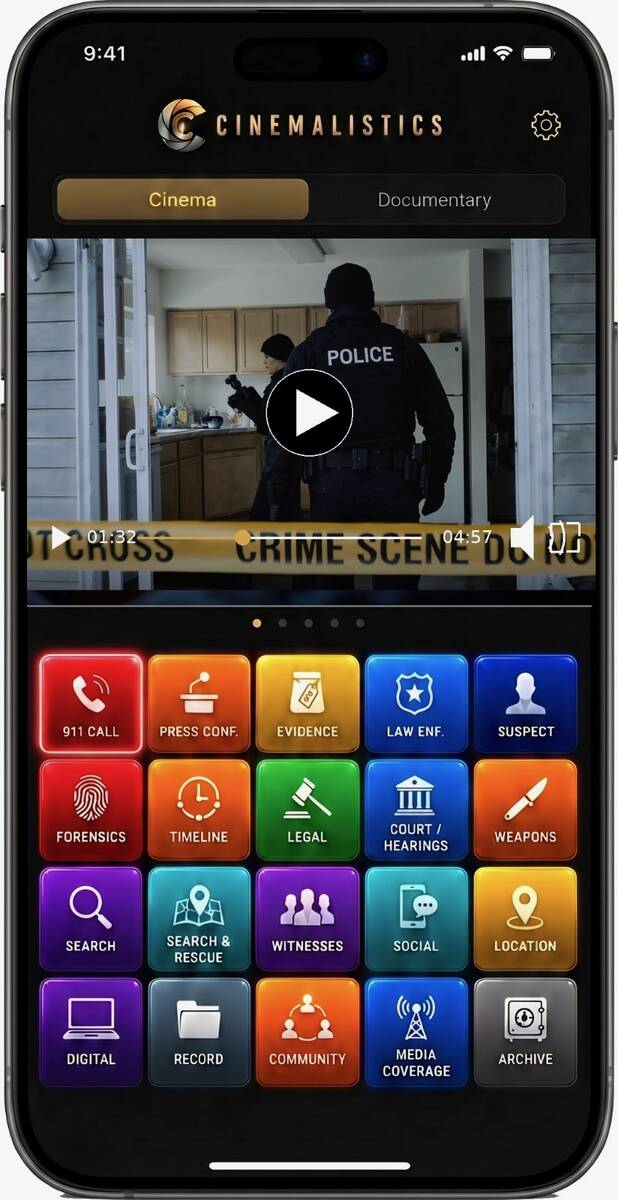
Cinemalistics, of which he’s one of four co-founders, will use artificial intelligence to generate cinema- and documentary-style footage of crimes that have captured the nation’s attention. Both versions of the stories will be updated as new information becomes public.
If a major case “breaks tomorrow, you are watching a rendition of it tomorrow,” Zuiker says. “It’s not going to be two years in development.”
Viewers can learn more about the case through its 20-button Head-Up Display.
“When you’re watching this rendition, these buttons will blink, which says, ‘This is where we have the 911 call.’ ‘This is where we have the press conference,’ ” Zuiker explains. “Once you hit the button, all the files and all the info is there.”
Cinemalistics is at least a year away from going live, he says. The divisiveness over the use of AI, though, isn’t likely to be resolved by then.
“I don’t know what the problem is,” Zuiker says. “Everybody’s sort of jumping on this bandwagon of ‘it’s bad’ and this and that. Here’s my philosophy: It’s not going away. It’s a tool that needs to be used. I use it every day for everything. And I thoroughly enjoy it.”
Contact Christopher Lawrence at clawrence@reviewjournal.com or 702-380-4567.

 Add as a preferred source on Google