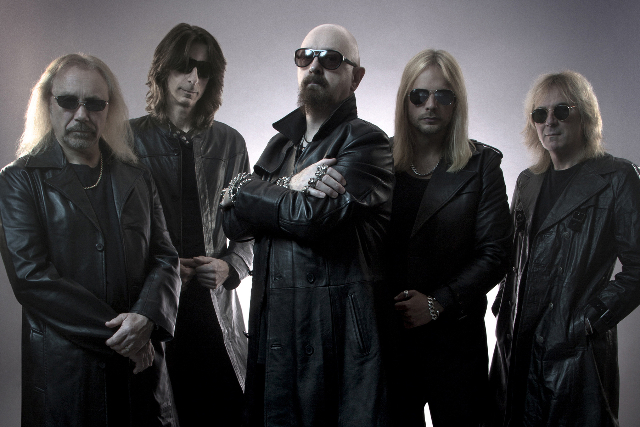
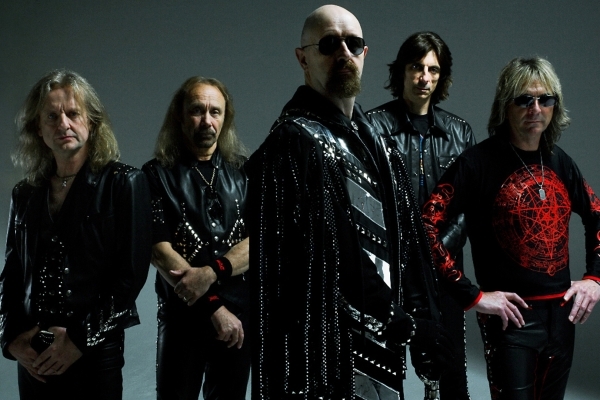
Judas Priest’s music holds timeless appeal for metal fans

At this stage of his career, Rob Halford, the frontman of Judas Priest who's widely regarded as one of the greatest and most influential metal singers of all time, could easily switch on the cruise control and coast into what could reasonably be considered the twilight of his career.
But you know what Dylan Thomas said about going gently into that good night. You're supposed to rage, rage against that sort of thing, and that's precisely what Halford is doing these days. At 64, he's performing with the vigor and determination of a man half his age. "When you've been in rock and roll for over 40 years," he notes, "you never take things for granted, regardless of how successful you've been."
Halford and his beloved British metal band have been plenty successful over the past four decades. Having released more than 20 albums worth of music between Judas Priest and side projects Fight, 2wo and Halford, the iconic frontman has absolutely nothing left to prove. To anybody. Don't tell that to Halford, though, or his bandmates, for that matter, who all still play with as much passion as they did at the very beginning.
"When you see Priest play, you do see that determination, because as I said earlier, we don't take anything for granted," Halford acknowledges. "We know that when set up at The Pearl, we have a lot of convincing to do still. We have a lot of ... we want to leave people, when the last notes have played, when they're walking around with those mental memories, we want people to say, 'That's my band! That's the band I love.' You know, 'They did exactly what I hoped they would do, and I want to see them again.'
"That's why we keep touring," he adds. "We might have a new record to promote, in some instances, but again, the bottom line is your fans need to want to come and see you again and again and again, and again, don't take that as an easy prospect. You've got to go out there and commit to work and prove why you're still able to do what you do.
"It's the real deal. And again, we think about, you've bought a ticket, you've taken money out of your pocket, you bought a ticket to come see this band, you know, we don't want you to walk away going, 'Well, that sucked,' or 'That was a bit disappointing,' or 'The guys didn't really seem to be working that hard tonight.' I think you know in advance now if you're a Priest fan that you are going to get a great show. You're going to see a band that you love and you're going to see them playing what they love to play."
And where they love to play. Halford first started coming to Las Vegas with Priest in the mid-'70s, back when Jimmy Carter was in office. He says he has great memories of that time period, some of which he relives from time to time through vintage 8 mm footage that he shot while his tour bus winded its way down the Strip to the Aladdin.
"All you see are those early venues, those early casinos — the Aladdin, Tropicana, the Hilton," Halford says of his old clips. "On this footage, you can actually see on the billboards the attractions: There, of course, is Elvis; there, of course, is Frank Sinatra; there, of course, is Engelbert Humperdinck, Tom Jones — all these big, iconic crooners, rock and rollers, performing, all at the same time on the Strip." Well, and at the same time as Priest, no less. "You can guess who went on first," Halford says, with a hearty laugh.
A lot has changed since those days, obviously. Halford, of course, has been back a number of times, both with Priest and on his own with Halford (opening for Iron Maiden, interestingly enough, on one of those trips, which is noteworthy because Maiden played its first U.S. show at the Aladdin, warming up for Priest). Of all the shows he and the band have done over the years, they always look forward to playing in Vegas, especially at the Palms, he says.
"We always have a blast," Halford says of playing at The Pearl. "That's a great room. That's a great room for live music. It's got that really kind of in-your-face attitude about it, you know. You can really, really see everything that the band is doing, no matter where you are in the room, and I think that kind of makes you work even harder, when you know you've got all those eyes locked on to everything that you do."
It's remarkable that after all these years of being on the road and playing tunes that he's played countless times that Halford sounds just as excited and engaged about being in front of a crowd as you imagine he was as a much younger man. And that's because he's thrilled to still be making music. Neither he nor his bandmates thought about making it this far into the future.
"There was this attitude, in the early days, that it was a young man's business," he explains. "It was a young man's game. It's a young man's experience. The shelf life of bands was very limited. I don't know when that changed. I think it's just been a very slow progression through the back end of the '60s and the '70s. A lot of people just became more attuned to the fact that, hey, this doesn't have to stop, just when you reach a certain point in your life. This doesn't have to finish because people go, 'How can you be a 60-year-old metalhead? That's for young people, you know.' "
Actually, when it comes to the music of Judas Priest, the appeal is ageless, as Halford and company have discovered this firsthand over the years from meeting their fans — and their fans' kids. " 'Hey, Rob, this is my son,' or 'this is my daughter,' " they'll say to Halford, "and they're already almost into their early teens or whatever, 'Yeah, I'm making sure they keep the faith,' and all that kind of stuff. It does your heart good. That's remarkable.
"I remember when I was growing up, you didn't like the music that mom and dad liked," he says. "And now, the kids are coming to Priest shows, putting the horns up with their mum and daddy at the side of them. I think that's pretty cool, man. I really do.
"You probably know that a lot of us that have had the good fortune to stay the course, whether it's Priest or Kiss or Maiden or Motorhead, AC/DC — there's a ton of bands that are still the backbone, really, of the rock and roll industry that have been going around the world doing what we do. It's just remarkable. It's just that power — the rock and roll power, I call it — that just has the ability to constantly touch people from every generation."
Indeed, but clearly there has to be more to it than that. It's the quality of the rock being produced and the care it's being delivered with, because after all, there are plenty of other acts who came along when Judas Priest did but have long since been forgotten.
"All of that initial groundwork, if you want to call it that, really enabled Priest to stand the test of time, if you want to use that expression," Halford concludes. "Here we are, man, 42, almost 43 years later, still loving what we do, and many of the fans are eager to see Priest again and again."
Read more from Dave Herrera at reviewjournal.com. Contact him at dherrera@reviewjournal.com.