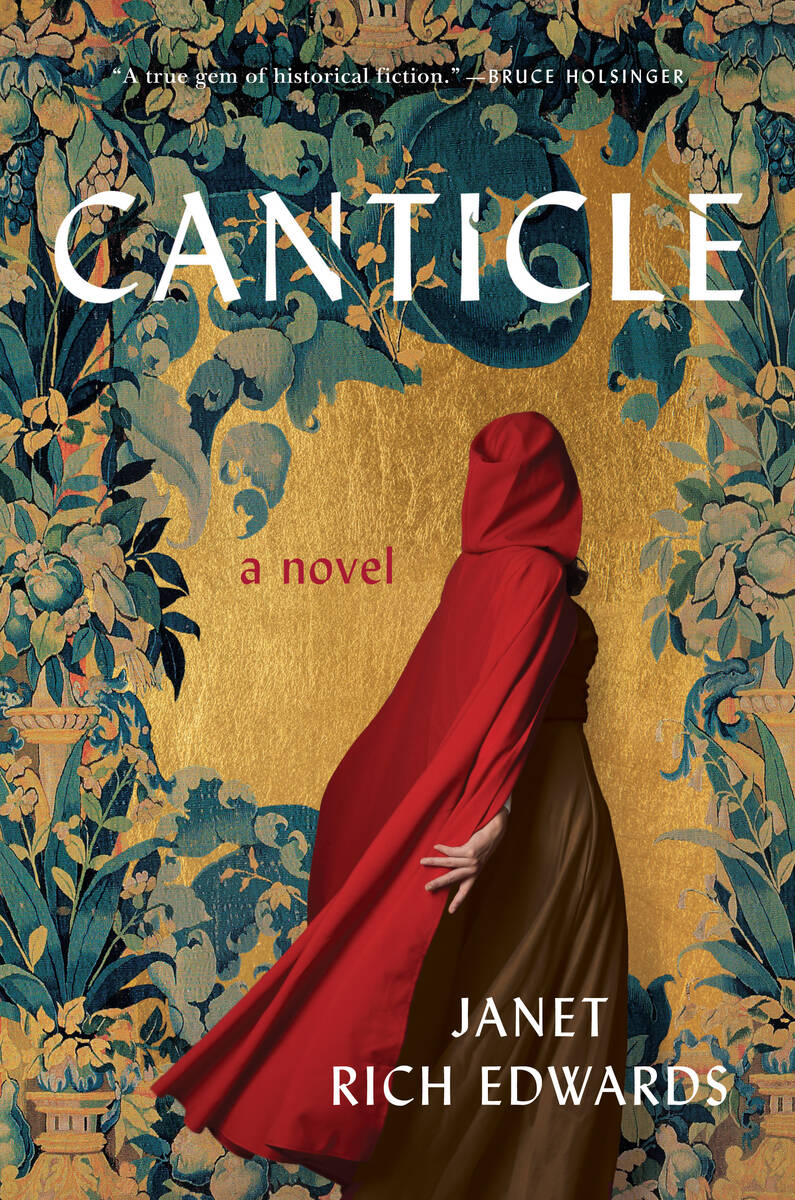
‘Canticle’ is a daring historical novel steeped in religious ecstasy

On the first page of “Canticle,” by Janet Rich Edwards, we see a 17-year-old girl walk toward the stake where she must be burned to death.
“Witnesses will later swear the girl was lit like a taper, and some will claim she had a halo,” Edwards writes. “No one is quite sure what happened.”
Ultimately, suspense plays no part in this story, though perhaps it never does for the truly faithful. Instead, readers get a rotating series of perspectives that, together, suggest something essential about the mystery and the terror of spiritual passion.
This medieval drama feels strangely out of place on the shelf of literary fiction, which has largely expelled the breath of the divine from its realm. We sophisticated readers have faith that novels will be sanctuaries of irony and psychological realism. Anything touched by an angel has been excommunicated, banished to the wilderness of fantasy, cheesy romance or Christian fiction where God knows what goes on.
Edwards, like her late-13th-century heroine, Aleys, is walking a treacherous path. With “Canticle,” her debut novel, she has created a bizarre story of miracles and martyrdom by drawing on equally bizarre stories about medieval mystics such as St. Clare of Assisi, St. Teresa of Avila and St. Catherine of Genoa. Some readers will catch echoes of Lauren Groff’s 2021 novel, “Matrix,” about the 12th-century poet Marie de France, but Edwards’s fidelity to the Christ-saturated imagination of the period is bolder — and, probably, less appealing to those modern readers who want historical women to be sweetened with modern feminist sensibilities like a Communion wafer dipped in honey.
“Canticle” begins in Flanders more than 700 years ago, when concerns about ecclesiastical corruption are already percolating. “The Church is uneasy,” Edwards writes, “a fat beast circling itself, snapping at its tail.” When we first meet Aleys, she’s a precocious girl who adores the Song of Solomon. Like many impassioned teenagers, she’s afraid “she’ll live her life and die in triviality.” Given the nature of the fervid religious tales surrounding her, perhaps it’s not so surprising that she fantasizes about being a martyr.
Edwards has a certain degree of fun with her heroine’s youthful conceit — and conceitedness. While teaching herself Latin, “Aleys tests her faith like she’s wiggling a loose tooth,” the narrator says. “She tries fasting, but after a day or two, though she pinches her thighs and is sure she’s wasting away, nobody notices. It’s a great disappointment. Aleys needs a hair shirt.”
There’s an earnestness to these early scenes — and others — that can sound precious, but Aleys’s childish notions quickly curdle in the crucible of experience. To avoid a lucrative marriage arranged by her father, she runs away to Brugge, a prosperous wool town, and commits herself to Friar Lukas, a melancholic ascetic who hopes to include women among his Franciscans. “You’ll be like Saint Clare,” he tells her. For the time being, though, he boards her with the local beguines, a community of devout women whose monastic life remains outside the bounds of the church.
Edwards carefully draws this liminal state between commerce and cloister. It’s just one of many illuminating aspects of her historical novel that reveals the clever ways some “unsupervised women” — quelle horreur — were able to define their own roles adjacent to an ecclesiastical system that severely limited their agency. Aleys, who expects to soar with angels’ wings, finds the work of cleaning, caring for the sick and making wool irritatingly pedestrian. Expecting to feed on ambrosia, she’s not convinced that Jesus can be found in servings of daily bread. But slowly, the beguines’ humble example begins to leaven her zealotry.
The problem, oddly, is her confessor, Friar Lukas. He and Aleys make a dangerous pair, though what’s most fascinating is the way Edwards distinguishes their animating passions. While Aleys struggles mightily to disentangle the threads of pride and devotion running through her mind, Friar Lukas is infected by jealousy for the divine light that bathes his young protégé.
They might have continued this tense pas de deux indefinitely, but one night while making her rounds at the hospital, Aleys stops to pray by the bedside of a dying boy. As she looks at the boy’s ghastly condition, her usual petitions have no effect. “It’s not enough. She knows it’s not enough,” Edwards writes. In desperation, she switches tacks and falls into a chant, “Ave Maria. … She does not stop when her vision grows murky, her hands begin to tingle. She sinks further into the prayer and the edges begin to blur and she bleeds into the boy and he bleeds into the prayer, and the prayer beats with his heart and she breathes the prayer. The spiraling words draw them together, deeper, into a space that is blue and gray, bound and unbound.”
This is daring territory for a contemporary novelist to enter. We possess an endless shelf of descriptions of people’s intimate sexual lives but relatively little that peeks behind the curtain of prayer. It’s as though the modern novel, so well designed to investigate social and romantic interactions, is too timid to intrude on our private ecstasy with the divine. What’s even more striking about Edwards’s effort to plumb the dimensions of faith is that it’s not inspirational. She’s not interested in converting us; she wants to draw us into the heart of the converted.
And in her telling, that’s a stormy place.
When the boy that Aleys prayed for suddenly rises up entirely healed, the town is electrified. “This changes everything,” one of the friars declares. But for Aleys, so determined to understand the true nature of God, it’s just one more agonizing mystery. Even as everyone in town heralds her as a miracle-performing saint, “Aleys feels more alone than she has in her life,” Edwards writes. “There’s no one to corroborate, no one to help her remember the details.” Although she knows she should feel grateful, instead she feels confused about what exactly happened with that boy. “What was it? What is she left with?”
What she’s left with is the difficulty of determining the validity of her revelations - a challenge that has bedeviled female visionaries down the centuries, from medieval mystics to Anne Hutchinson in the earliest days of the American colonies. The Brugge authorities are naturally skeptical, but the townspeople are eager to rend Aleys limb from limb for a scrap of her holy clothing or even a piece of her blessed flesh.
Wide is the gate and broad is the way that a novel like this could go wrong. But Edwards effectively balances the story’s religious fervency with the presence of a cynical bishop who adds a delicious touch of wit and menace to this spiritual melodrama. He has no intention of letting miracles, a young mystic or even God get in the way of his climb toward Rome. And “Canticle” also includes an intriguing subplot about vernacular translations of the Bible being written by local women in defiance of church law.
“Canticle” is itself something of a daring act of translation. Edwards manages to produce a modern narrative that remains leashed to ancient experience and the evolving religious practices of the era — some shockingly peculiar. By preserving the ideals and even the phrases of actual medieval mystics, she keeps her story from turning into a costume drama pleasingly decorated with New Age gobbledygook. The Aleys we follow into the flames remains fanatical and weird and devoted in a way that passeth all understanding and yet feels purified by love.