
D-Day drama ‘Pressure’ makes the weather worth watching

The premise of “Pressure,” the new World War II movie from director Anthony Maras and writer David Haig, is a hyperfocused look at the days leading up to D-Day with a special focus on the meteorologists.
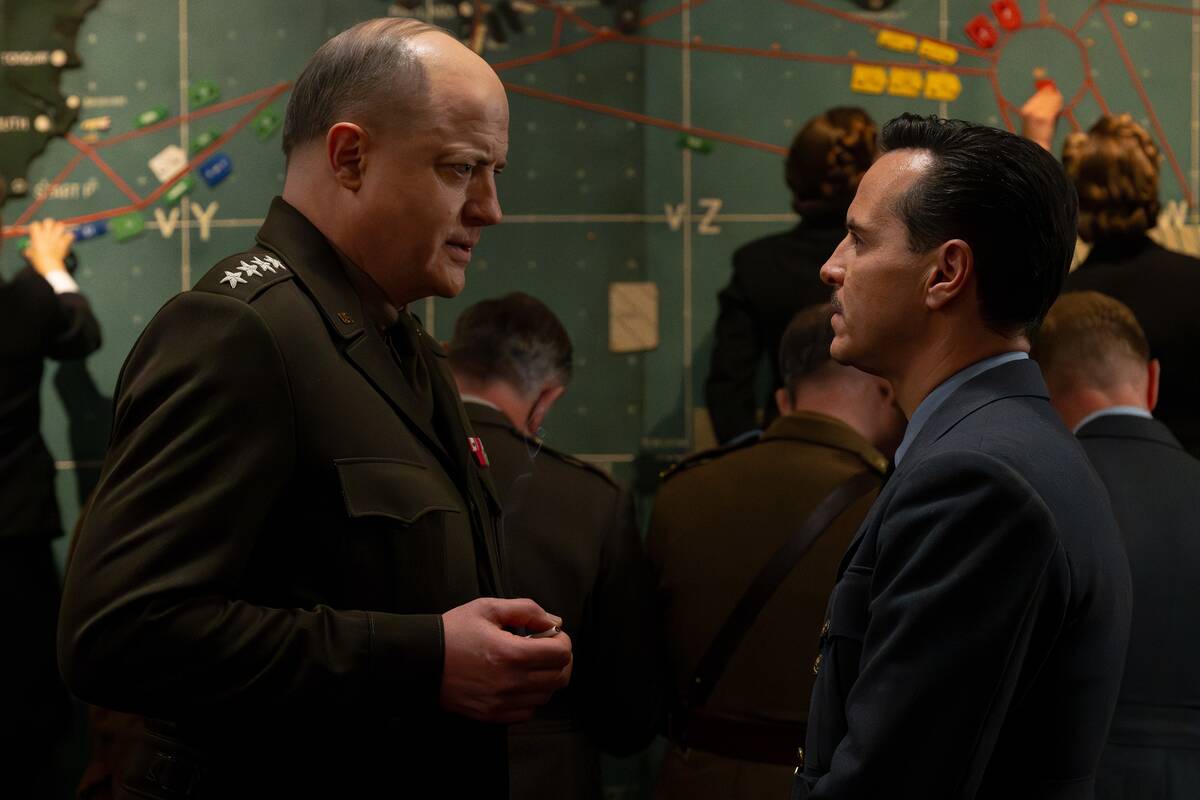
It’s a one-setting thriller set in the pressure cooker of General Dwight D. Eisenhower’s war room at an English country estate that works backward from the 1961 Eisenhower quip to JFK that attributed his success in Normandy to the Allies having “better meteorologists than the Germans.”
If you’re skeptical about how exciting a movie about the weather on D-Day might be, Maras and Haig take that as a creative challenge, an argumentative stance from which to start. For the next hour and 40 minutes, Maras and co-writer Haig, who also wrote the 2014 play from which the film is adapted, explain to us exactly how important the meteorologists of D-Day were, starting from the high-stakes context of the disastrous D-Day rehearsal Exercise Tiger.
With the weather app at our fingertips these days, it can be hard to imagine just how difficult it was to forecast the weather in the 1940s, especially in northern Europe. That was the predicament facing Eisenhower (Brendan Fraser) just 72 hours before the planned D-Day launch of June 5, 1944. But we know that D-Day happened on June 6, so the arrival at that date is part of the film’s narrative intrigue.
After a devastating glimpse of Exercise Tiger, red blood mixing with blue ocean waves and white sandy beaches, we’re quickly introduced to our protagonist, Group Captain Chief Meteorologist James Stagg (Andrew Scott), in his cozy home with his pregnant wife before he’s swept into critical war planning.
He’s stern, terse and no-nonsense. Stagg is the kind of person who wants to be correct more than he wants to be liked, and he insists on a careful collection of live data, using weather balloons, phone calls and mathematical charting. His foil is Colonel Irving Krick (Chris Messina), a charming American meteorologist and Eisenhower’s chosen weatherman, a yes-man who relies on selectively chosen historical data, and a persuasive speaker whose approach rankles the fastidious Stagg.
Eisenhower instructs the two men to come to an agreement, and “Pressure” follows the ups and downs of their working relationship over the course of several days.
But “Pressure” is a truly two-hander between Scott and Fraser as Stagg and Eisenhower. Stagg and his firm belief that a storm on June 5 will make conditions less than ideal is the immovable object against which Eisenhower rages, while he simultaneously attempts to placate a phalanx of military personnel who all have different needs.
The script — and Fraser’s explosive performance — underline the immense, well, pressure the general is under while balancing every precarious element of this enormous mission.
While Fraser delivers an external performance as the tough American general, Scott offers a restrained depiction of the repressed and methodical Stagg. When he finally bursts with a cathartic 11th hour speech about the inaccuracy of Krick’s historical forecast, based on past war trauma, Eisenhower listens. Scott is so good at this kind of acting, processing every emotion internally, but allowing just enough to show to let the audience into his character’s emotional state.
In a quiet conversation with Eisenhower’s close confidant and aide, Kay Summersby (Kerry Condon), she jokes that weathermen are boring. Stagg reminds her that the weather itself isn’t, though. Weather feeds us, it can destroy us — it rules our existence, he says. “People ask, ‘when will the wind stop blowing?’ No one ever asks, ‘why does the wind blow? What is the wind?’” revealing himself as a sort of philosophical poet of the weather.
His forecast was the crucial edge in D-Day, and Maras and Haig make the weather worth watching.
"Pressure"
3½ stars out of four

 Add as a preferred source on Google